Long before mass literacy, image carried meaning.
In the upper chamber of Longthorpe Tower, figures emerge faintly from plaster. Painted in the fourteenth century, they form one of the most significant surviving schemes of medieval domestic wall painting in England. Allegorical scenes, moral symbolism and narrative detail unfold across the surface. They were not intended for spectacle. They were designed for contemplation within everyday life.
Their survival is rare. Their intimacy is striking.
These paintings remind us that expression in Peterborough was never confined to monumental space. While carved stone shaped public identity, pigment shaped interior imagination. Meaning lived at multiple scales.
Earlier still, in the twelfth-century, in a Romanesque sculptural programme at Peterborough Cathedral, symbolic animals and hybrid creatures were carved into capitals and façades. These bestiary figures were not decorative flourishes. They were narrative devices. A lion might signify courage or Christ. A grotesque beast might warn against vice. Stone became a teaching tool in an age when literacy was limited.
To carve or paint is to believe that values should be seen.
In this way, visual culture became an early form of shared language. It required interpretation. It invited reflection. It assumed that the viewer was capable of reading symbol as well as script.
Across centuries, that confidence in the image endured.
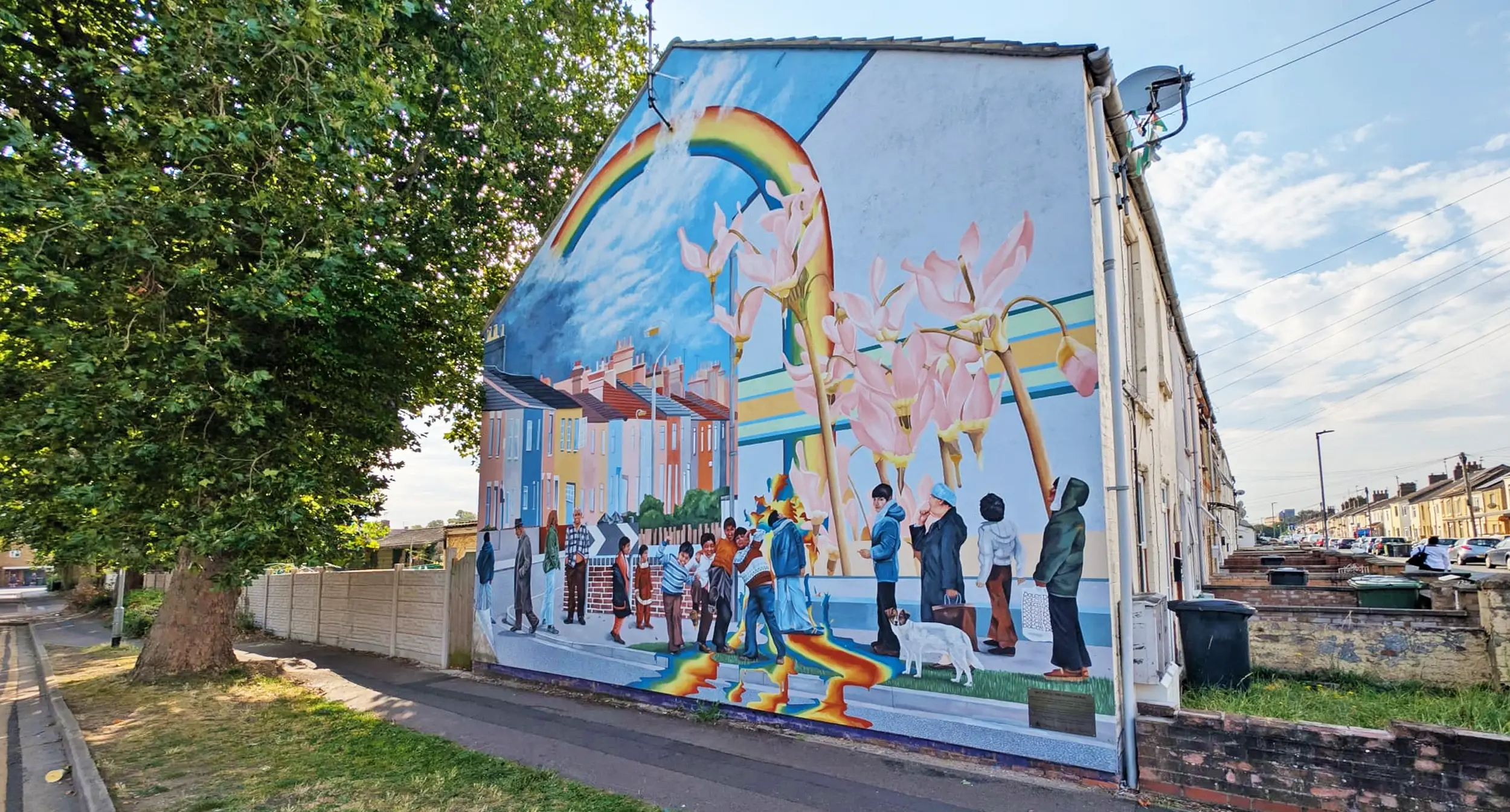
Today, public art continues to transform Peterborough’s walls into narrative surfaces. Murals appear beneath railway arches and along city streets. Installations animate parks and public squares. Peterborough’s public art maps a network of contemporary visual expression that spans neighbourhoods and generations.
Where medieval allegory once encoded spiritual lessons, contemporary works explore identity, migration, ecology and belonging. The themes shift. The act remains the same. Meaning is made visible.
The lineage is not theoretical. It is lived.
Each year, Peterborough Artists Open Studios invites residents into studios and homes across the city. Artists open private working spaces to the public, sharing process as well as product. There is something quietly resonant in this gesture. Medieval wall paintings once embedded imagination into domestic interiors. Today, those interiors open outward, inviting conversation.
This annual opening of studios has become part of the city’s creative rhythm. Running for more than two decades, it is sustained not by spectacle but by participation. It reflects a place comfortable with art embedded in everyday life.
Expression becomes invitation.
The recognition of artists such as Rene Matić on the national stage reinforces that this is not peripheral creativity. Contemporary visual language shaped here resonates beyond it. Experience becomes image. Image becomes discourse.
Across centuries, the mediums have shifted from carved limestone to mineral pigment, from brush to spray paint, from allegorical chamber to open studio. What has not shifted is the instinct to encode meaning in form.
Peterborough has long trusted the eye.
Image here is not ornament.
It is interpretation.
It carries history, invites conversation and leaves room for the viewer to participate in meaning-making.
If stone gave the city its first visible voice, image gave that voice nuance and depth.
And in that depth, character became more complex.
#Peterborough2029
#ThisIsPeterborough
#DiscoverPeterborough